What Does “Campy” Mean? And Why Subtlety is Overrated.
Tonight we follow a word through time. A word that laughs at seriousness, winks at shadows, and drapes itself in velvet exaggeration.
That word is campy.
And like many things in CacklePatch’s world, it is both playful and peculiar—its roots tangled somewhere between theatrical mischief and secret language whispered behind gloved hands.
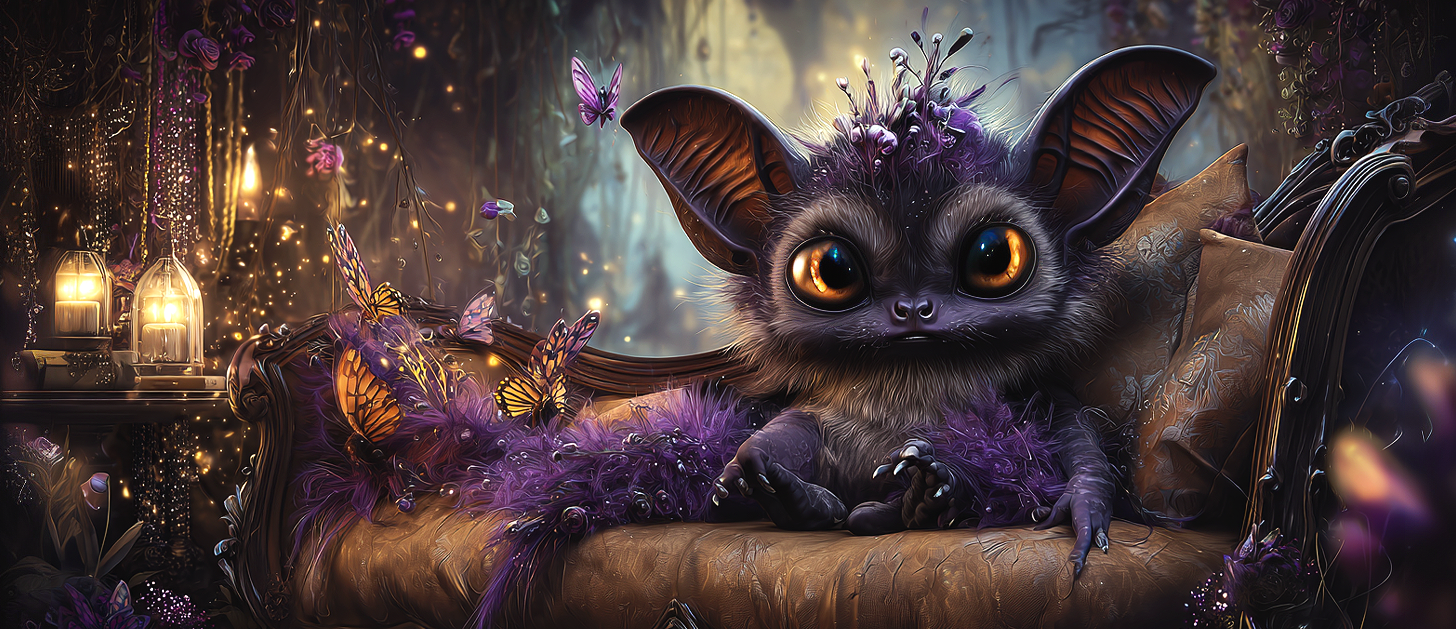
A Word That Refused to Behave
The term camp (from which campy blooms like a mischievous mushroom) is widely believed to have emerged in the 19th century, though its precise origin is deliciously elusive—much like a raccoon who refuses to explain why your silverware has gone missing.
Some scholars trace it to the French word se camper, meaning to pose or to strike an exaggerated stance. Imagine it: a dramatic figure, chin lifted too high, gesture too grand, emotion dialed past sincerity into spectacle.
Already, we feel the spirit of camp stirring.
But camp does not simply describe posing—it became a coded language where it evolved into a way of seeing the world: one that celebrates artifice, exaggeration, theatricality, and irony.
To call something campy is not to mock it—it is to revel in its bold refusal to be subtle.
The Theater of Too Much
Camp thrives in excess.
Plumes of feathers.
Gallons of glitter.
A performance so dramatic it teeters on the edge—and then leaps.
One key distinction: camp is not accidental.
True camp is intentional or, at the very least, felt as meaningful. It transforms the ordinary into spectacle, the serious into playful, and sometimes the tragic into something strangely liberating.
In the mid-20th century, writer Susan Sontag’s Notes on Camp asserts: “Camp taste is, above all, a mode of enjoyment, of appreciation—not judgment...[it] is a kind of love, love for human nature. It relishes, rather than judges, the little triumphs and awkward intensities of ‘character.’”
Like CacklePatch himself, it resists neat definitions.
Campy in the World of CacklePatch
If you wander through ShadowSleep Hollow on the right night, you might notice something curious:
A jack-o’-lantern wearing a monocle
A bat who insists on dramatic pauses mid-sentence
A witch who stirs her tea as if conducting an orchestra
This, dear reader, is camp.
It is the celebration of too muchness.
The joy of careening into the absurd.
The refusal to dim one’s peculiar glow.
CacklePatch, in his top hat festooned with stolen liberated trinkets and theatrical flair, embodies camp not as performance alone—but as philosophy. He does not simply exist—he performs existence.
And in doing so, he invites us to do the same.
Why Camp Matters (Yes, Even in the Shadows)
Campy expression has long offered a kind of freedom—a way for people to express identity, humor, and resistance when the world demanded seriousness or conformity.
It says:
If I must exist in your world, I shall do so extravagantly.
There is something deeply human in that impulse. Psychologically, exaggeration allows us to explore identity at a safe distance, like dressing up during Halloween or Purim. Sociologically, it creates community among those who recognize the wink behind the performance.
Camp is not shallow. It is layered, knowing, and often quietly defiant.
A Final Flicker of Candlelight
So when you call something campy, do not mistake it for mere silliness.
You are naming a tradition of theatrical rebellion.
A lineage of glittering defiance.
A style that says: Why whisper when you can echo through the rafters?
In the world of CacklePatch—and perhaps in your own shadowed corners—camp is an invitation:
To exaggerate.
To delight.
To become wonderfully, unapologetically too much.
After all…
Weird is Wonderful.
And sometimes, it deserves a spotlight.